初中级Lower intermediate在线实验室Online lab可打印Printable
元素猜拳:均匀出招也会被看穿?
Element Duel: Can a Balanced Pattern Still Be Predicted?
同样数序列,这次要预测对手并选择反制动作。比较只数频率和记住上一招的区别。
Count sequences to predict an opponent and choose a counter. Compare overall frequencies with what follows the last move.
火、水、草各出一样多,就不容易被猜中吗?试试“火、水、草、火、水、草……”这位对手。
Are equally frequent Fire, Water and Nature moves hard to predict? Try Fire, Water, Nature, Fire, Water, Nature…
开始之前Before you start
计算出招频率与一阶转移次数,给出预测和反制动作,并分别记录预测正确率与对局胜率。
Count frequencies and one-step transitions, make a prediction and counter, and record prediction accuracy separately from game wins.
会计数;先学猜词更顺。约定水胜火、火胜草、草胜水,同时出招。
Count events; Guess the Word is a useful starting point. Water beats Fire, Fire beats Nature, Nature beats Water; reveal simultaneously.
一步一步试试看Try it step by step
- 先猜(5分钟):练三次反制:猜对方火就出水,猜水就出草,猜草就出火。预测对不对和有没有赢,是两列不同的记录。Predict (5 min): counter predicted Fire with Water, Water with Nature and Nature with Fire. Record correct predictions separately from wins.
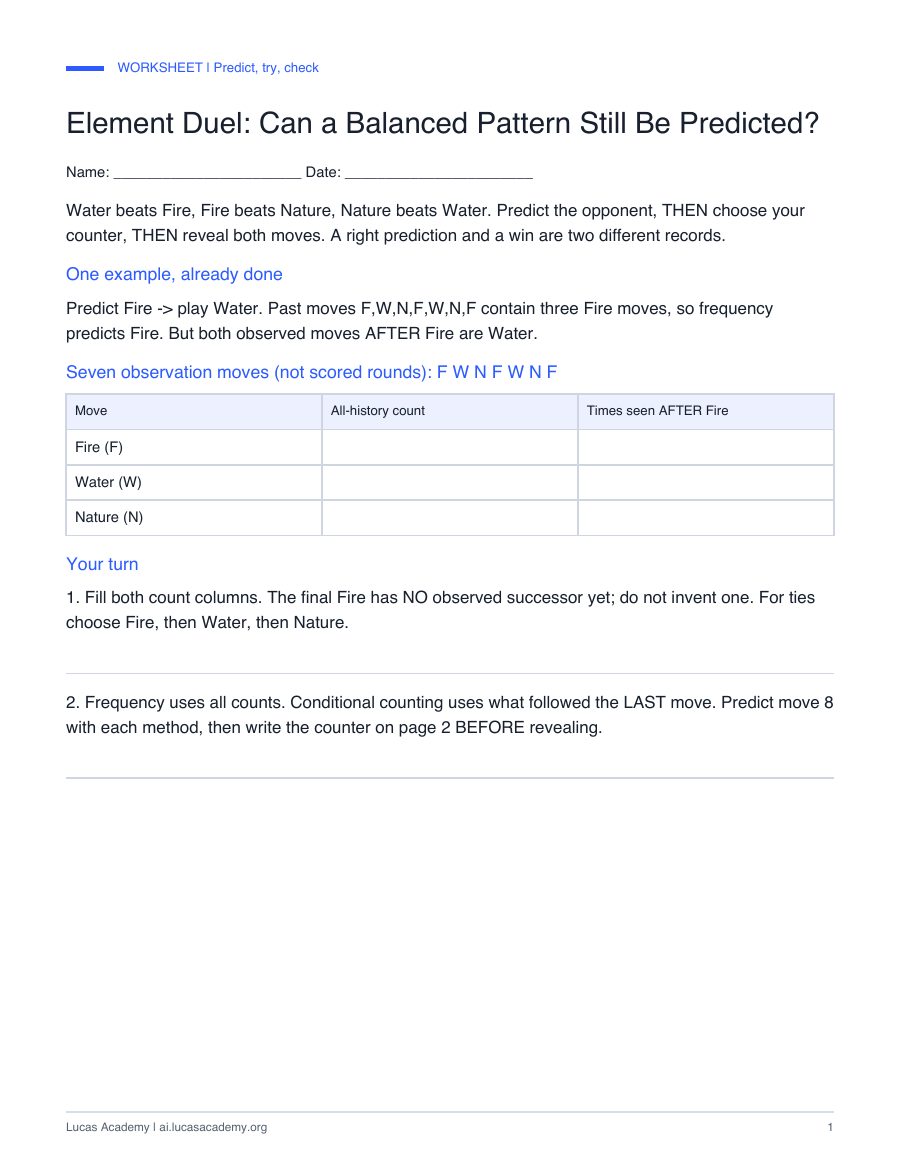
- 动手(10分钟):先看七招历史“火水草火水草火”。只数频率会选什么?若平手按火、水、草顺序选,记录选择规则。Play (10 min): inspect seven moves F,W,N,F,W,N,F. What does frequency predict? Break ties in the declared order Fire, Water, Nature.
- 观察(10分钟):只数过去“火后面接什么”:两次接水。把这个预测变成反制动作,再揭晓第八招;不能先看当前对手动作。Observe (10 min): count what followed Fire in past transitions: Water twice. Counter that prediction, then reveal move eight; never inspect the current opponent move first.
- 挑战(10分钟):换成可复现的随机对手,先固定轮数再比。均匀频率不能证明独立随机;短局输赢也不能证明预测器永远有效或无效。Challenge (10 min): switch to a reproducible random opponent and fix the number of rounds before comparing. Balanced counts do not prove independent randomness; short-run wins do not establish universal performance.
一起算一个例子Work through one example
如果预测对方是火,就出水。七招火水草火水草火的频率是3、2、2,所以频率法猜火;看到最后一招火时,条件计数法根据过去两次火→水来猜水。
Counter predicted Fire with Water. F,W,N,F,W,N,F has counts 3,2,2, so frequency predicts Fire. Given the final Fire, conditional counting uses two earlier F→W transitions and predicts Water.
先想一想,再看答案Think first, then check
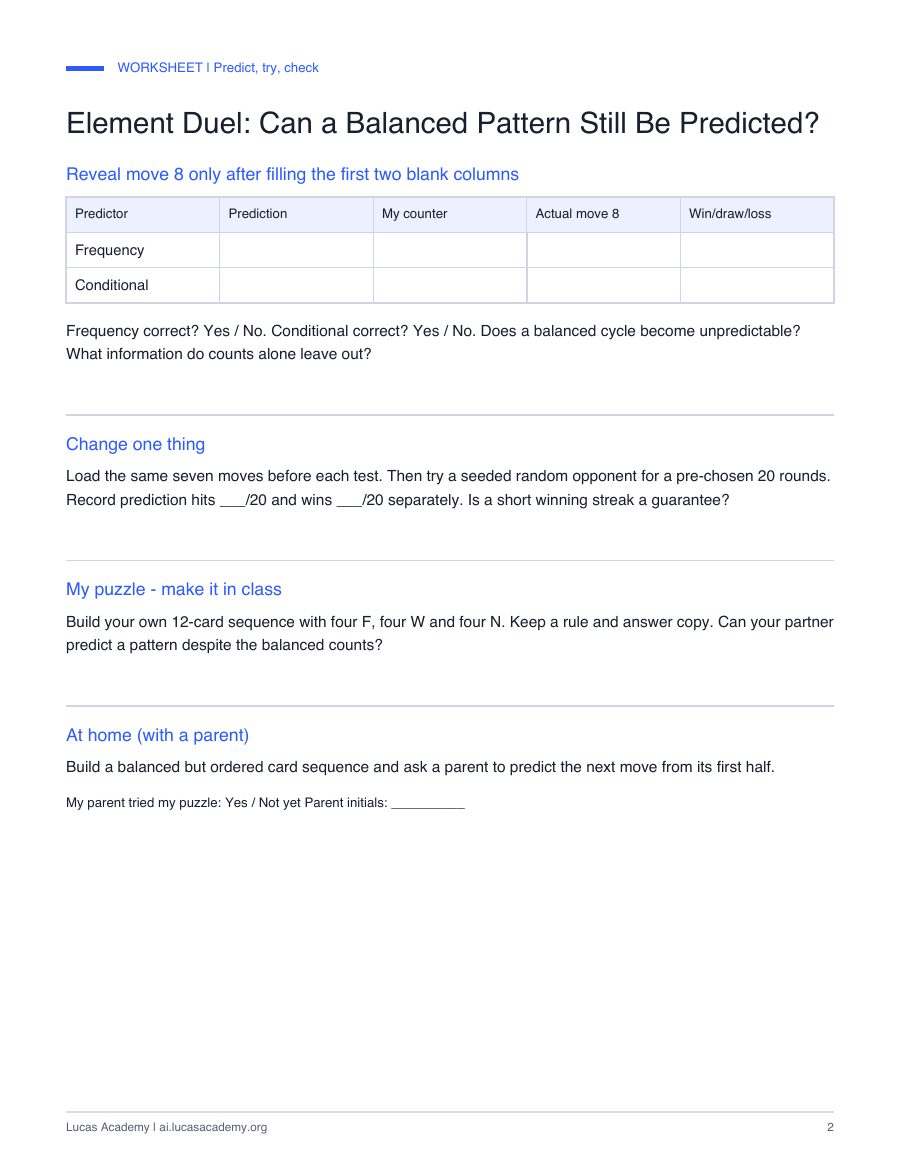
第八招若为水,两种预测器各会出什么?猜对动作是否自动等于赢?每种动作一样多,是否就不能预测?
If move eight is Water, what does each predictor play? Does predicting correctly automatically mean a win? Do equal counts imply unpredictability?
查看参考答案Show the expected answer
频率法猜火、出水,遇水平;条件法猜水、出草,遇水赢。猜对还需要选对反制动作,不能把预测准确率当胜率。七招计数3/2/2;火的两个已观察后续都是水,所以这段样本的条件比例2/2=100%,不是下一次必然如此的保证。循环序列长期三种频率相同,顺序仍可预测。独立公平随机时,任何只看过去的预测在期望上正确1/3,短局会波动;课堂用有种子的伪随机。
Frequency predicts Fire and plays Water: a draw against Water. Conditional counting predicts Water and plays Nature: a win. A correct prediction still needs the correct counter. Counts are 3/2/2; both observed Fire successors are Water, so the sample proportion is 2/2=100%, not a guarantee. A cycle can be balanced yet predictable. Against independent fair random moves, a past-only forecast has expected accuracy 1/3, with short-run variation; the lab uses seeded pseudorandomness.
这个实验说明了什么What this experiment shows
课堂版不把猜中加分混入胜率;原项目部分读心关有预测奖励分。这里只实现频率与一阶条件计数,不把它称为神经网络,也不声称能识破所有确定性程序。
The classroom version keeps prediction counts separate from wins; some original reading levels award prediction bonuses. This lab implements frequency and first-order conditional counting, not a neural network or a predictor of every deterministic program.
学习单Worksheets
学习单用英文,可打印给孩子。教师指南随页面语言下载:当前为中文版。
Print the English worksheets for the children. The guide follows the page language: English is selected.
下载学习单(PDF)Download worksheets (PDF)教师指南(中文 PDF)Teacher guide (English PDF)
继续玩原项目Explore the original game
课堂实验可以离线使用。原项目有更多模式,可由老师带领继续探索。
The classroom lab works offline. The original project has more modes for teacher-led exploration.
视频与文章Videos and reading
- Lucas Academy: original game 原项目与玩法original project and game